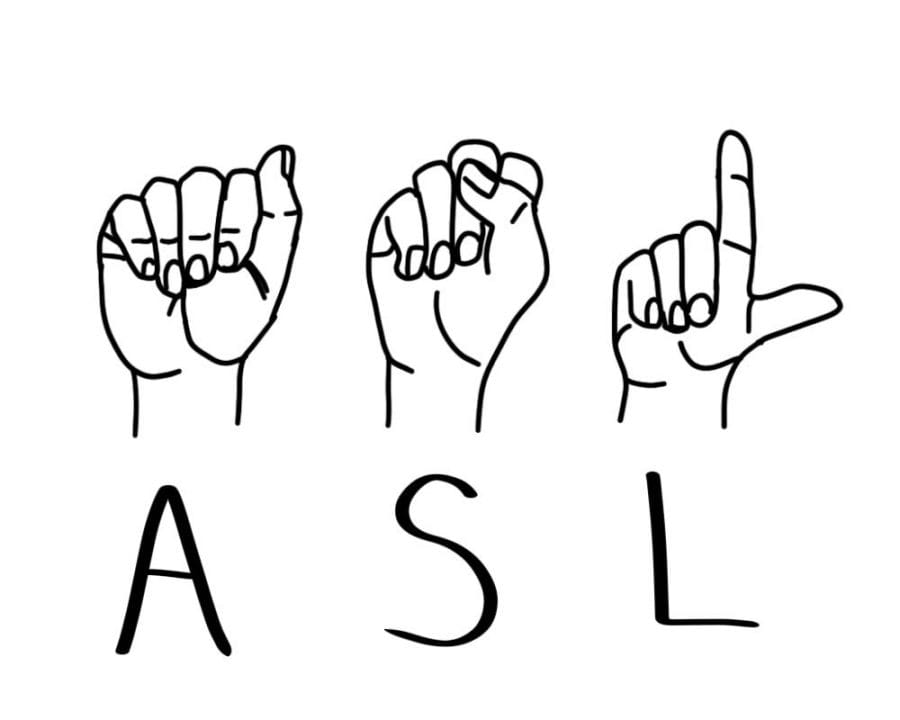
I went to a mixed primary school that included hearing, deaf, and hard-of-hearing students. Growing up in that environment, many of us hearing students naturally picked up American Sign Language (ASL) to communicate with our deaf peers; on the basketball court, while joking around, or simply hanging out.
When it was time for secondary school, five of us from my class ended up at the same school. We already knew ASL, which immediately set us apart. Out of 63 students spread across Year 7A, 7B, and 7C, only five of us could sign, and even then, with varying levels of proficiency. We naturally looked out for one another and occasionally used ASL to gossip, safe in the knowledge that no one else could understand.
By the end of the third term of our first year, during exam season, something surprising had happened. More students had started learning ASL, but not out of curiosity. Around a dozen students picked it up, but only enough to sign numbers 0–9 and letters A–E.
Why A–E? Our exams were split into multiple-choice questions (MCQs) and theory sections, with MCQs labeled A to E. These students learned exactly what they needed to cheat and nothing more. They weren’t trying to master the language; they just wanted a shortcut to passing. Our school was notorious for failing and repeating students who didn’t meet the required threshold, so the motivation was clear: survive, even if it meant taking the easy way out.
It wasn’t until Year 9 that teachers finally caught on. By then, ASL had spread like wildfire. Nearly half the school, around 200 students, could sign. Seniors and juniors alike had picked it up. For years, it had gone unnoticed because teachers assumed we were just kids making random gestures.
What struck me most was how few students went beyond the basics. Most learned ASL just to cheat, using it as a shortcut rather than a skill. A few mastered the full alphabet, enough to finger spell gossip across the room. Only a handful showed genuine curiosity, borrowing our old ASL dictionaries, asking questions, seeking out introductions to our deaf friends, and practicing whenever they could.
Those students who relied on shortcuts surprised me. In the primary school I came from, curiosity was relentless, sometimes to the point of annoyance. Half-learned knowledge felt incomplete, even foreign. We thirsted to understand, not just to earn marks, and cheating was unthinkable. Learning was an adventure, not a transaction, and the difference was impossible to ignore.
That contrast led my 9/10 year-old self to an early realisation about curiosity and human nature. I began to notice differences I hadn’t seen before. You might think, well, duh, people are different, but my primary school environment had been relatively socially and academically homogeneous. We were more alike than different.
Over time, I identified three categories of people.
The first category, despite fully intending to cheat, didn’t bother learning even the most rudimentary ASL, just enough to avoid getting caught. During exams, they relied entirely on others, interrupting those who had learned the basics to get MCQ answers. They outsourced both the work and the learning.
The second category showed more initiative. These students learned just enough ASL to overcome immediate blockers, either cheating during exams or gossiping, but never went further. They didn’t improve their ASL, nor did they improve their study habits enough to no longer need it. Once the obstacle was cleared, their curiosity stopped.
The third category went all in. They moved past the basics, learned the language properly, practiced consistently, and genuinely wanted to understand.
Interestingly, the same pattern showed up among our teachers.
Most had noticed the gestures but assumed we were just being kids. A few suspected there was more to it but couldn’t quite place it. Only one teacher kept digging. He started asking questions: Who taught you this? Where did you learn it? The trail eventually led back to the five of us.
At first, he looked for obvious similarities, same neighborhoods, same backgrounds, but nothing stood out. It wasn’t until a new student joined our class from the same primary school that the real connection became clear: we had all attended the same primary school and learned ASL there years earlier.
As I grew older, I noticed the same pattern repeatedly, especially once I started working.
Sometimes I help colleagues who get blocked during sprint tasks. When I step in to resolve an issue, the curious ones ask questions: How did you figure it out? What did you try? Why did this work? The next time they encounter a similar problem, they move through it effortlessly.
Then there’s the other group. They’re content with the immediate fix, unbothered, uncurious. Weeks or months later, they’ll ping you again with the same or a very similar issue, because they never cared to understand it in the first place.
This distinction matters even more in a startup or scale-up environment.
Curiosity is a compounding advantage. Startups operate under constant uncertainty. There’s rarely a playbook, rarely enough documentation, and almost never enough time. Problems repeat, but rarely in the same form. In that environment, raw intelligence alone isn’t enough.
Curious people scale.
Uncurious people create drag.
A curious hire doesn’t just unblock themselves once; they reduce the likelihood of needing help the next time. They ask why, trace systems to their roots, and build mental models that transfer across problems. Over time, they become force multipliers.
The other category optimizes only for completion. The task gets done, but the understanding never compounds. The same issues resurface, the same questions get asked, and the same dependencies remain. In a large organisation, this might go unnoticed. In a startup, it’s expensive.
That’s why, when hiring, I care less about whether someone knows the answer and more about what they do when they don’t. Do they ask thoughtful questions? Do they experiment? Do they follow their curiosity beyond what’s strictly required to finish the task?
In a startup, you don’t need people who know everything. You need people who are curious enough to understand everything they touch.
When I interview, I look for candidates who light up when they talk about something they figured, out not something they were told. That spark is often the difference between someone who survives in a startup and someone who helps it grow.
In an ideal world, you hire people from the third category the ones whose curiosity doesn’t shut off once the task is done. In reality, you can sometimes make room for the second category. With the right environment, some of them grow into the third.
What you can’t afford, especially in a startup or scale-up, is the first category. People who won’t learn, won’t take initiative, and rely on others to carry them forward don’t just slow themselves down; they drain the team. And in a small, fast moving company, that cost compounds quickly.
Whether it’s a classroom, a codebase, or a company, the people who go beyond what’s required are the ones who move things forward.
📌 Laughed this week?
Check out → Tweets That Cracked Me Up